Voxolo›Trip guides›Christmas markets
Find official 2026 dates for 45 markets, plus a printable phrase card in German, French, Italian and Spanish.
Then practice the reply. Hear the exchange and answer out loud in Voxolo. Your first lesson is free, with no account needed.

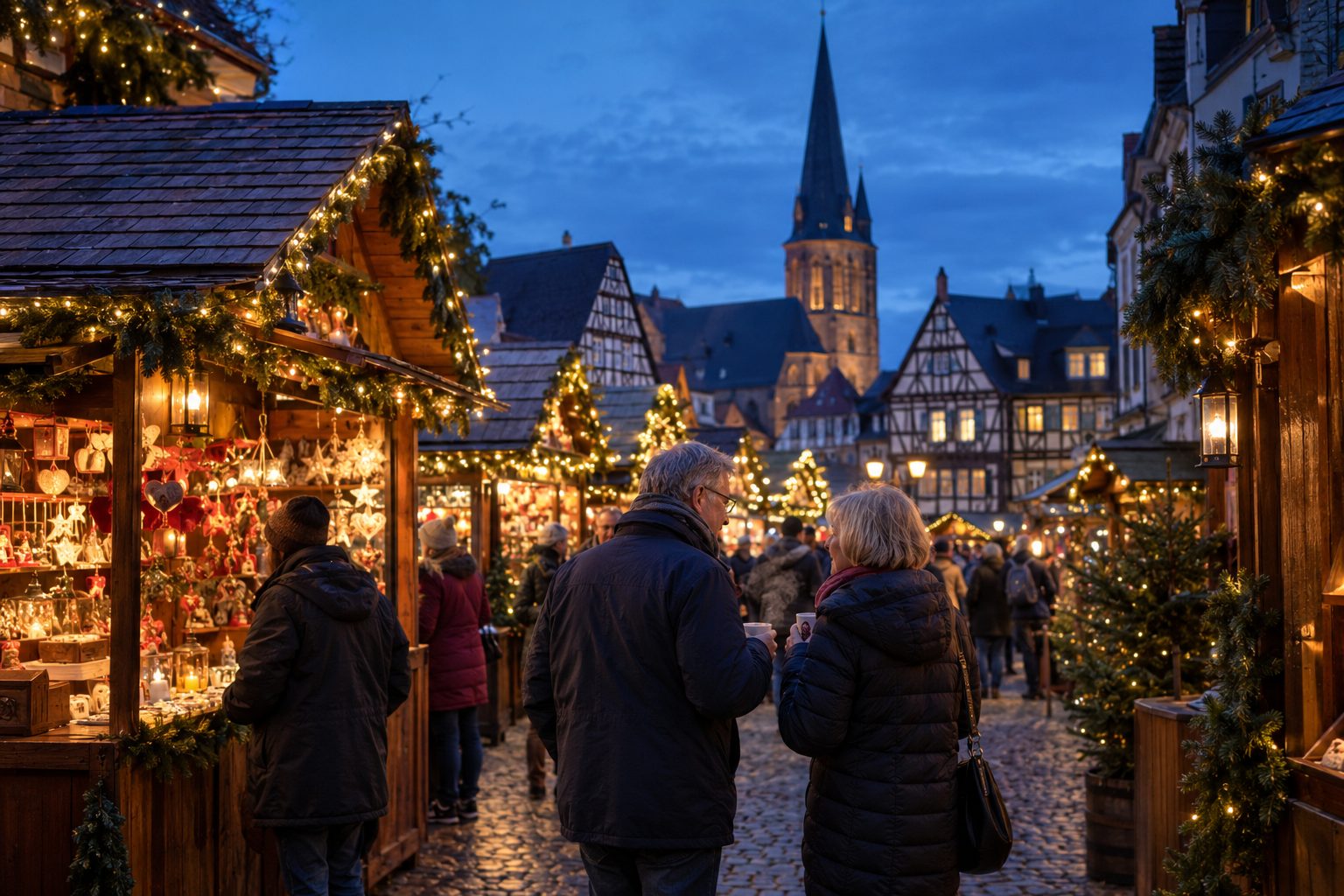
A Christmas market stall is a six-line exchange, and it's nearly the same six lines in every country. Learn these and you can work a market all evening:
The stallholder's reply comes fast. Hear it and practice answering out loud in Voxolo. The first lesson is free.
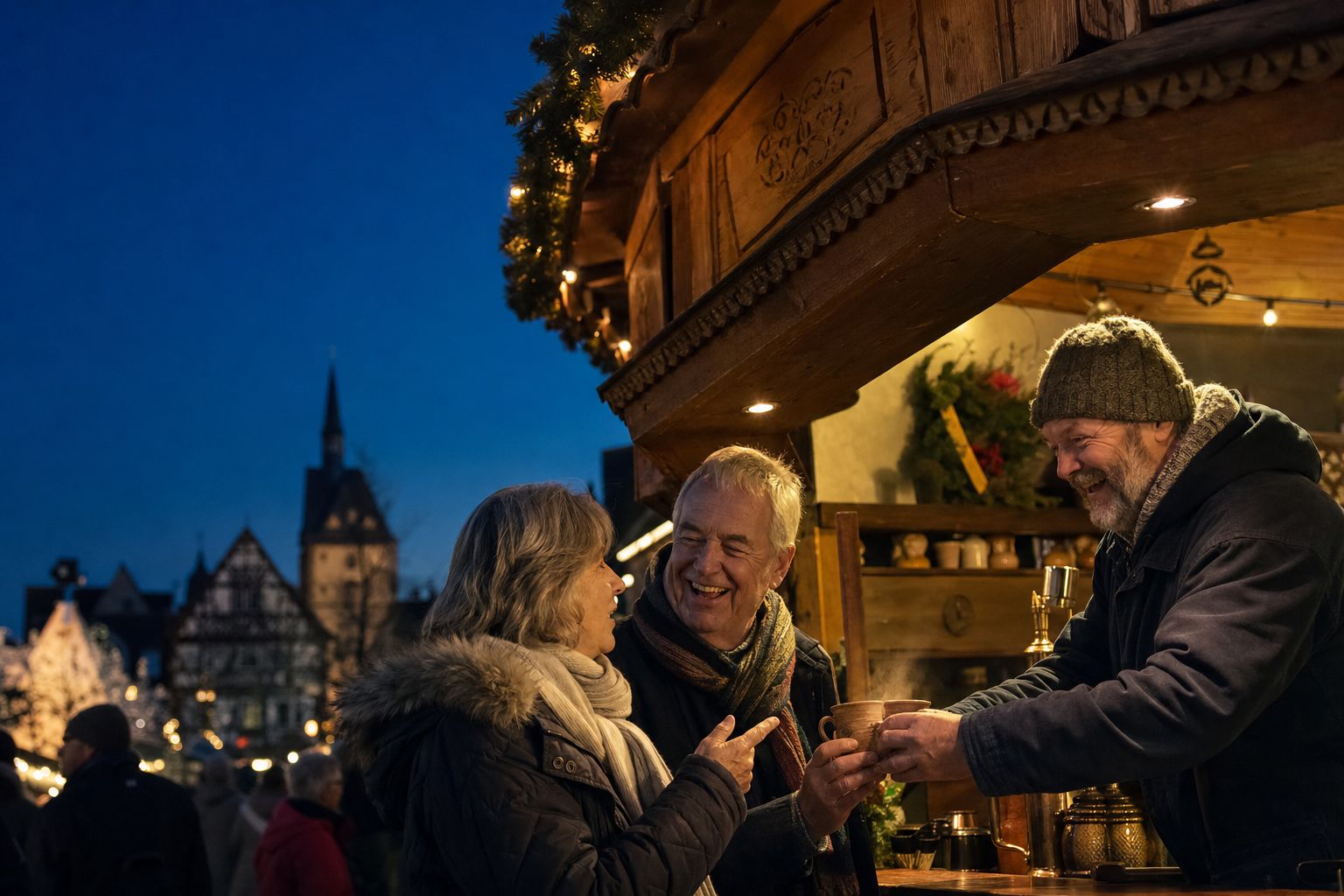
It's six o'clock in Nuremberg, dark since four, and there's a queue three deep at a hut with a copper vat. Here's how the next ninety seconds go — both sides of it.
Nobody says a full sentence here. Market ordering is the most forgiving speaking you will do all trip: the noise, the queue and the cold have compressed every transaction down to a noun and bitte. If the whole phrase deserts you, "Glühwein, bitte" with two fingers held up is a complete and unremarkable order.
"Mit Schuss" means a shot of rum or amaretto stirred into the wine — and it is not a small one. Kinderpunsch is the alcohol-free version and is not remotely a children's-only order: it's the same spiced apple base every driver, every non-drinker and half the market is holding. Ordering one draws no comment at all.
This is the moment that catches nearly every first-timer. Eight fifty for a mug of hot wine feels like a tourist tax, and it isn't one — five euros of that is the drink and three fifty is a deposit you get back. Knowing the word Pfand before you hear the number is the difference between feeling fleeced and feeling fluent.
Take the mug by the handle and the rim, not the body. Ceramic straight out of a vat at near-boiling is the most common small injury at a Christmas market, and gloves are no help — they just delay the moment you notice.
You do not have to return it to the stall that sold it to you at most German markets — any stall on the same market will usually take it and refund the deposit. Keep the paper receipt if you're given one. And if you want it: keeping the mug is the intended outcome, not a loophole.
The tall standing tables are shared, always. Hovering nearby waiting for one to empty is the behaviour that reads as strange — walking up to four strangers, asking, and putting your mug down is the normal one. It is also, reliably, where your evening turns into a conversation you did not plan on having.
The drink changes, the deposit word changes, the rest is the same transaction. Here's the opener in each language, and what the deposit is called when the price surprises you.
Every hot drink comes in a real ceramic mug, and the price includes a refundable deposit on it. Pfand in German, consigne (or caution) in French, cauzione in Italian. In Germany that deposit commonly runs €2–5 on a €4–6 drink, so your first round can land near €10 and feel like you've been read as a tourist. You haven't. Hand the mug back at any stall and the deposit comes straight back to you.
Or keep it — that is what the system is for. Most markets commission their own mug each year, shaped and glazed for that city and stamped with the year, and collecting them is a genuine local habit rather than a tourist affectation. A Nuremberg 2026 mug costs you the deposit and nothing more, weighs less than a guidebook, and is the rare souvenir you will actually use. Travelers who work this out on day three of a market-hopping trip tend to spend day four buying back the ones they returned.
Two practical notes. Some markets hand you a paper token or receipt with the drink — that's your deposit slip, and losing it can cost you the refund. And at markets that share a deposit scheme across the whole square, you can return the mug to any hut, not only the one that sold it. Ask "Kann ich den Becher hier zurückgeben?" (kahn ikh dayn BEKH-er heer tsoo-RUEK-gay-ben) — can I return the mug here?
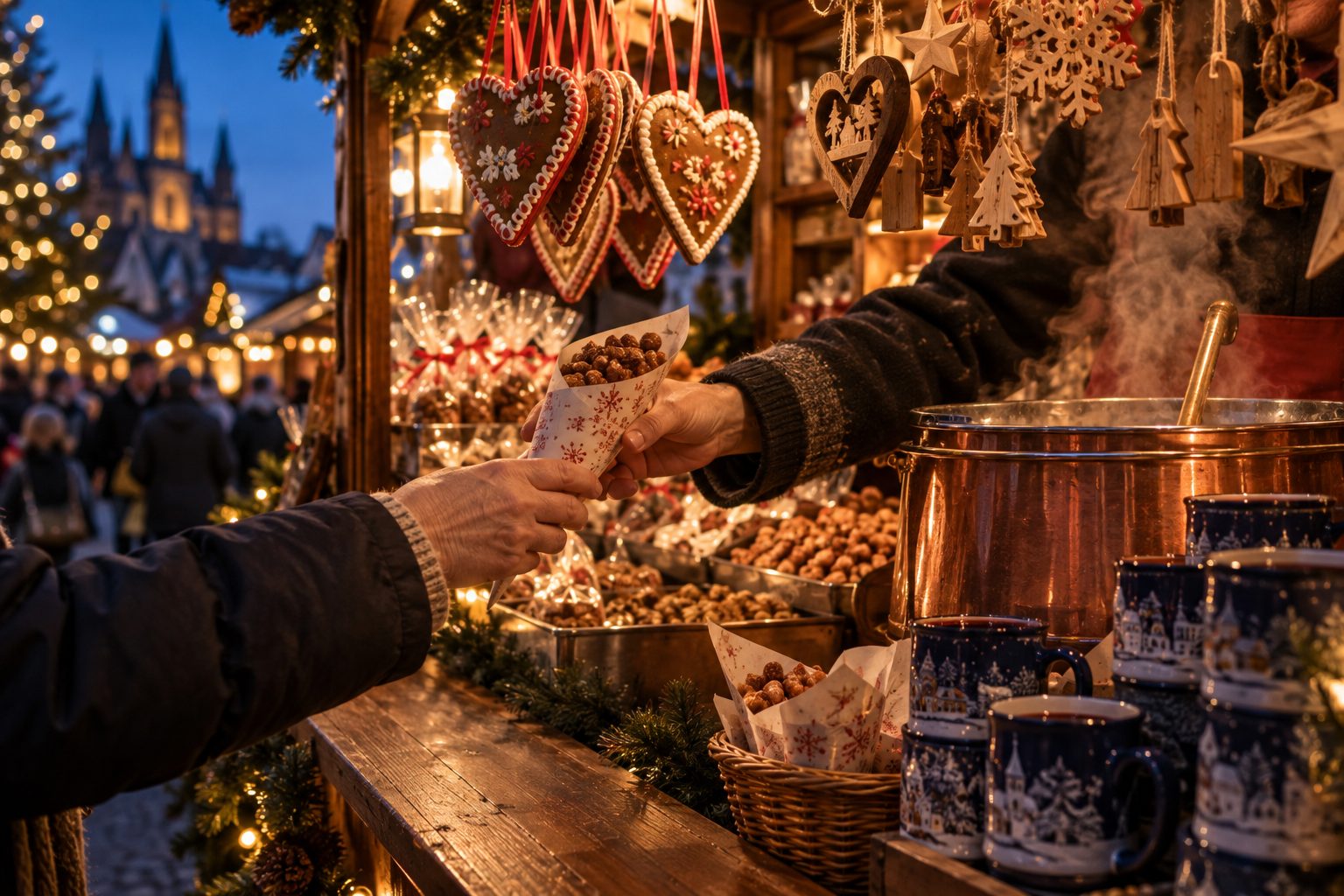
Christmas market food is regional to a degree that surprises people who have only read the word "Christmas market." These are the words worth recognising on a chalkboard in the dark.
The German market menu is not trying to be a meal. It's a series of things you can eat with one hand while holding a hot mug in the other.
Alsace is the heart of the French Christmas market, and it is culturally half-German — which is exactly why its market food is its own thing rather than a copy of either neighbour.
Italy's great Christmas markets are in Alto Adige / Südtirol, a bilingual province where Austrian and Italian traditions sit on the same table — often on the same plate.
Spanish Christmas markets are craft-and-nativity markets, not drinking markets, and the Spanish Christmas season keeps going long after Germany has packed up. The gift-giving climax is Reyes — Epiphany, 6 January.
These are not themed attractions built for tourism. Most of them predate the countries they stand in — and a couple exist because of arguments about religion that are still legible in the names.
The Striezelmarkt is generally accepted as the oldest true Christmas market in the world, first documented in 1434 as a one-day market before Christmas. It takes its name from the Striezel — from Middle High German strutzel, a long, sometimes braided yeast pastry — which is the direct ancestor of the Dresden Stollen sold there today.
Older records exist for Vienna (1298), Munich (1310) and Frankfurt (1393), which is where the "oldest market" argument comes from. Those were December markets: general fairs for laying in winter provisions. Dresden's was tied to Christmas itself, which is why it usually wins the title.
Strasbourg's Christkindelsmärik — Alsatian for "market of the Christ Child" — was created in 1570 by a decision of the city's Council of Twenty-One, after the Protestant preacher Flinner argued for replacing the Saint Nicholas fair with a celebration centred on the Christ Child rather than a saint.
It moved to Place Broglie in 1871 and stayed. For centuries it was effectively the only Christmas market in France; today it anchors a city that brands itself Capitale de Noël and spreads 300-odd chalets across the Grande Île.
Nuremberg's market is opened each year by the Christkind, a golden-haired, gold-robed figure who recites a prologue from the gallery of the Frauenkirche on the Friday before the first Sunday of Advent. It is the single best-timed thing to catch at any German market, and it takes fifteen minutes.
The Christkind itself is Luther's doing — gift-giving was moved off Saint Nicholas's Day to Christmas Eve, with the Christ Child replacing the saint. Since 1969 the role has been elected every two years from local girls aged 16 to 19. The job description includes a head for heights: the balcony is high, and December in Franconia is not kind.
The Fira de Santa Llúcia has been held beside Barcelona's cathedral since 1786, and began as a fair for the feast of Saint Lucy on 13 December. Its 160-odd stalls sell almost entirely one thing: the components of a household pessebre — the nativity scene, assembled figure by figure across years.
Among those figures is the caganer, a squatting peasant in a red barretina cap, trousers down, traditionally hidden at the back of the scene. Documented since at least the 18th century, he's read as a fertility charm and as a deliberate levelling joke: whatever else is going on in the stable, everybody is still human.
Forty-five markets across 19 countries, checked against the organizer, city or official tourism site on . Use the country filter for a quick answer, then open the source before booking.
Many classic German markets still close on 22, 23 or 24 December. Dresden, Nuremberg, Munich and Hamburg are finished by Christmas Eve, so a trip between Christmas and New Year needs a different base.
Late-December travelers have plenty of options — just not everywhere. Berlin, Düsseldorf, Brussels, Salzburg, Prague, Tallinn, Zagreb and several Alpine markets continue after Christmas; some run through Epiphany on 6 January. Holiday closures and short hours still apply, so use the linked source for the final check.
Planning one of these trips? Practice ordering, asking about the deposit and answering the vendor before you arrive.
Practice with VoxoloShowing all 45 markets.
| Market | 2026 season | Worth knowing |
|---|---|---|
| Germany · 11 markets | ||
| 🇩🇪 Dresden · Striezelmarkt | 25 Nov – 24 Dec Official dates ↗ | Germany's oldest; short hours on Christmas Eve. |
| 🇩🇪 Nuremberg · Christkindlesmarkt | 27 Nov – 24 Dec Official dates ↗ | The Christkind opens the market at 5:30pm on 27 November. |
| 🇩🇪 Munich · Marienplatz | 20 Nov – 24 Dec Official dates ↗ | Closed on 22 November; closes 2pm on Christmas Eve. |
| 🇩🇪 Frankfurt · Römerberg | 23 Nov – 22 Dec Official dates ↗ | More than 230 stalls through the city centre. |
| 🇩🇪 Berlin · Gendarmenmarkt | 23 Nov – 31 Dec Official dates ↗ | A useful German option after Christmas. |
| 🇩🇪 Cologne · Cathedral Market | 16 Nov – 23 Dec Official dates ↗ | The Old Town market continues into January, but the cathedral market does not. |
| 🇩🇪 Leipzig | 24 Nov – 23 Dec Official dates ↗ | About 300 stalls spread across seven city-centre areas. |
| 🇩🇪 Hamburg · Rathausmarkt | 23 Nov – 23 Dec Official dates ↗ | Look up at 4pm, 6pm or 8pm for the flying Santa. |
| 🇩🇪 Düsseldorf · City Centre | 19 Nov – 30 Dec Official dates ↗ | Closed 22 November and 25 December; open again on Boxing Day. |
| 🇩🇪 Aachen | 20 Nov – 23 Dec Official dates ↗ | Daily around the cathedral and town hall; try Aachener Printen. |
| 🇩🇪 Stuttgart | 25 Nov – 23 Dec Official dates ↗ | Known for elaborately decorated stall roofs across the old centre. |
| Austria · 4 markets | ||
| 🇦🇹 Vienna · Rathausplatz | 13 Nov – 26 Dec Official dates ↗ | The Schönbrunn and Prater winter markets continue to 6 January. |
| 🇦🇹 Salzburg · Cathedral Square | 19 Nov – 1 Jan Official dates ↗ | Open through Christmas week, with special holiday hours. |
| 🇦🇹 Innsbruck · Old Town | 13 Nov – 23 Dec Official dates ↗ | Other Innsbruck markets at Maria-Theresien-Strasse and Hungerburg run to 6 January. |
| 🇦🇹 Graz · Hauptplatz | 20 Nov – 24 Dec Official dates ↗ | One of several markets within an easy walk of each other. |
| France · 3 markets | ||
| 🇫🇷 Strasbourg · Christkindelsmärik | 26 Nov – 24 Dec Official dates ↗ | Eight markets across the historic centre; final day ends at 6pm. |
| 🇫🇷 Colmar | 23 Nov – 29 Dec Official dates ↗ | Six markets in the old town; open on 25 and 26 December. |
| 🇫🇷 Lille · Place Rihour | 18 Nov – 30 Dec Official dates ↗ | Closed on Christmas Day; the Grand-Place Ferris wheel stays into January. |
| Italy · 3 markets | ||
| 🇮🇹 Bolzano · Mercatino di Natale | 27 Nov – 6 Jan Official dates ↗ | Italy's original Christmas market; German and Italian throughout. |
| 🇮🇹 Merano · Kurpromenade | 26 Nov – 6 Jan Official dates ↗ | Closed on Christmas Day; riverside stalls reopen on the 26th. |
| 🇮🇹 Trento | 20 Nov – 6 Jan Official dates ↗ | Two market squares; open from 4pm on Christmas Day. |
| Central & Eastern Europe · 5 markets | ||
| 🇨🇿 Prague · Old Town Square | 28 Nov – 6 Jan Official dates ↗ | The Wenceslas Square market follows the same dates. |
| 🇵🇱 Wrocław · Market Square | 20 Nov – 7 Jan Official dates ↗ | One of the latest-closing big markets in this directory. |
| 🇸🇰 Bratislava · Main Square | 26 Nov – 3 Jan Official dates ↗ | Closed 24 and 25 December; otherwise open daily to 10pm. |
| 🇭🇷 Zagreb · Advent Zagreb | 28 Nov – 7 Jan Official dates ↗ | A city-wide festival with several market and music zones. |
| 🇱🇻 Riga · Doma Square | 27 Nov – 1 Jan Official dates ↗ | Open on Christmas Eve, Christmas Day and Boxing Day with holiday hours. |
| Belgium & the Netherlands · 3 markets | ||
| 🇧🇪 Brussels · Winter Wonders | 27 Nov – 3 Jan Official dates ↗ | More than 200 chalets through the centre; 6pm close on 24 and 31 December. |
| 🇳🇱 Maastricht · Vrijthof | 27 Nov – 27 Dec Official dates ↗ | Free square entry; rides and the covered ice rink are ticketed. |
| 🇳🇱 Valkenburg · Christmas Town | 13 Nov – 3 Jan Official dates ↗ | Known for ticketed underground markets in the town's caves. |
| Switzerland · 4 markets | ||
| 🇨🇭 Basel · Barfüsserplatz & Münsterplatz | 26 Nov – 23 Dec Official dates ↗ | About 150 stalls across two old-town squares. |
| 🇨🇭 Zurich · Old Town | 19 Nov – 23 Dec Official dates ↗ | The main-station and Münsterhof markets run one day longer. |
| 🇨🇭 Montreux Noël | 20 Nov – 24 Dec Official dates ↗ | Lakefront market; closes at 5pm on Christmas Eve. |
| 🇨🇭 Bern · Sternenmarkt | 19 Nov – 27 Dec Official dates ↗ | Closed on Christmas Day; the Waisenhausplatz markets return after Christmas. |
| Nordic & Baltic countries · 6 markets | ||
| 🇪🇪 Tallinn · Town Hall Square | 20 Nov – 6 Jan Official dates ↗ | A strong option for the week after Christmas. |
| 🇱🇹 Vilnius · Cathedral Square | 28 Nov – 27 Dec Official dates ↗ | The Christmas train continues through 6 January. |
| 🇳🇴 Bergen · Festplassen | 20 Nov – 22 Dec Official dates ↗ | More than 90 stalls in the city centre. |
| 🇳🇴 Oslo · Jul i Vinterland | 7 Nov – 3 Jan Official dates ↗ | Open daily except Christmas Eve. |
| 🇩🇰 Copenhagen · Tivoli Gardens | 13 Nov – 3 Jan Official dates ↗ | A ticketed amusement park as well as a Christmas market. |
| 🇸🇪 Stockholm · Stortorget | 22 Nov – 23 Dec Official dates ↗ | Sweden's oldest Christmas market, open daily in Gamla Stan. |
| United Kingdom · 4 markets | ||
| 🇬🇧 Manchester · City Centre | 6 Nov – 22 Dec Official dates ↗ | Albert Square and Cathedral Gardens continue to 3 January. |
| 🇬🇧 Birmingham · Frankfurt Market | 5 Nov – 24 Dec Official dates ↗ | A large German-style market in the city centre. |
| 🇬🇧 Bath | 26 Nov – 13 Dec Official dates ↗ | Only 18 days; quieter shopping is Tuesday or Wednesday morning. |
| 🇬🇧 Edinburgh · Princes Street Gardens | 14 Nov – 3 Jan Official dates ↗ | Part of a three-site city-centre Christmas festival. |
| Spain · 2 published ranges | ||
| 🇪🇸 Madrid · Plaza Mayor | Late Nov – 31 Dec Official range ↗ | Exact opening day is still TBA; 104 stalls focus on nativity figures and decorations. |
| 🇪🇸 Barcelona · Fira de Santa Llúcia | Late Nov – 23 Dec Official pattern ↗ | City protocol sets the final weekend of November through 23 December; exact opening day is still TBA. |
| No markets match that search. Try a city, country or market name. | ||
Around 50 phrases in four languages, grouped by the moment you'll need them. Prints black and white, no images. On an iPhone: Share → Print, or Share → Save to Files for a PDF you can open with no signal.
Christmas Market Phrases — German · French · Italian · Spanish
Voxolo · voxolo.app/christmas-market-phrases.html · CEFR A2 · pronunciation in italics
| 🇩🇪 Einen Glühwein, bitte. | One mulled wine, please. | AY-nen GLUE-vine, BIT-teh |
| 🇩🇪 Zwei Glühwein, bitte. | Two mulled wines, please. | tsvy GLUE-vine |
| 🇩🇪 Einen Kinderpunsch, bitte. | One spiced punch, no alcohol. | AY-nen KIN-der-poonsh |
| 🇫🇷 Un vin chaud, s'il vous plaît. | One mulled wine, please. | uhn van SHOH, seel voo PLEH |
| 🇫🇷 Un vin chaud blanc, s'il vous plaît. | One white mulled wine. (Alsace) | van SHOH BLAHN |
| 🇮🇹 Un vin brulé, per favore. | One mulled wine, please. | oon veen broo-LAY, per fa-VOH-reh |
| 🇮🇹 Due, per favore. | Two, please. | DOO-eh, per fa-VOH-reh |
| 🇪🇸 Un chocolate caliente, por favor. | One hot chocolate, please. | cho-ko-LAH-teh ka-lee-EN-teh |
| 🇩🇪 Wie viel Pfand ist auf dem Becher? | How much is the mug deposit? | vee feel PFANT owf daym BEKH-er |
| 🇩🇪 Ich möchte den Becher behalten. | I'd like to keep the mug. | ikh MURKH-teh dayn BEKH-er beh-HAL-ten |
| 🇩🇪 Becher zurück, bitte. | Mug back, please. (refund) | BEKH-er tsoo-RUEK, BIT-teh |
| 🇫🇷 C'est combien, la consigne ? | How much is the deposit? | say kohm-BYAN, la kon-SEEN-yuh |
| 🇫🇷 Je garde la tasse. | I'll keep the cup. | zhuh GARD la TAHSS |
| 🇫🇷 Je rends la tasse. | I'm returning the cup. | zhuh RAHN la TAHSS |
| 🇮🇹 Quant'è la cauzione? | How much is the deposit? | kwan-TEH la kow-TSYOH-neh |
| 🇮🇹 Vorrei tenere la tazza. | I'd like to keep the mug. | vor-RAY teh-NEH-reh la TAHT-tsa |
| 🇩🇪 Was ist das? | What is that? | vahs ist DAHS |
| 🇩🇪 Das da, bitte. | That one there, please. (pointing) | dahs dah, BIT-teh |
| 🇩🇪 Eine Bratwurst, bitte. | One sausage, please. | AY-neh BRAHT-voorst |
| 🇫🇷 C'est quoi, ça ? | What's that? | say KWAH, sa |
| 🇫🇷 Ça, s'il vous plaît. | That one, please. (pointing) | sa, seel voo PLEH |
| 🇮🇹 Che cos'è? | What is it? | keh koh-ZEH |
| 🇮🇹 Quello lì, per favore. | That one there, please. | KWEL-loh LEE |
| 🇪🇸 ¿Qué es esto? | What is this? | keh es ES-toh |
| 🇪🇸 ¿Tiene turrón de Jijona? | Do you have soft turrón? | TYEH-neh too-RRON deh hee-HOH-na |
| 🇩🇪 Mit Schuss? | With a shot of rum in it? | mit SHOOSS |
| 🇩🇪 Sonst noch etwas? | Anything else? | zonst nokh ET-vahs |
| 🇩🇪 Vorsicht, heiß! | Careful, hot! | FOR-zikht, HYCE |
| 🇫🇷 Et avec ceci ? | And with that? (anything else) | ay ah-VEK suh-SEE |
| 🇫🇷 C'est tout ? | Is that everything? | say TOO |
| 🇮🇹 Altro? | Anything else? | AL-troh |
| 🇪🇸 ¿Algo más? | Anything else? | AL-goh MAHS |
| 🇩🇪 Was kostet das? | How much is that? | vahs KOS-tet dahs |
| 🇩🇪 Nehmen Sie Karte? | Do you take cards? | NAY-men zee KAR-teh |
| 🇩🇪 Stimmt so. | Keep the change. | shtimt zoh |
| 🇫🇷 C'est combien ? | How much is it? | say kohm-BYAN |
| 🇫🇷 Vous prenez la carte ? | Do you take cards? | voo pruh-NAY la KART |
| 🇮🇹 Quanto costa? | How much is it? | KWAN-toh KOS-ta |
| 🇮🇹 Accettate la carta? | Do you take cards? | ah-chet-TAH-teh la KAR-ta |
| 🇪🇸 ¿Cuánto cuesta? | How much is it? | KWAN-toh KWES-ta |
| 🇪🇸 ¿Aceptan tarjeta? | Do you take cards? | ah-SEP-tan tar-HEH-ta |
| 🇩🇪 Ist hier noch frei? | Is this spot still free? | ist heer nokh FRY |
| 🇩🇪 Frohe Weihnachten! | Merry Christmas! | FROH-eh VYE-nakh-ten |
| 🇫🇷 C'est libre, ici ? | Is this spot free? | say LEE-bruh, ee-SEE |
| 🇫🇷 Joyeux Noël ! | Merry Christmas! | zhwah-YUH no-EL |
| 🇮🇹 È libero? | Is it free? (of a spot) | eh LEE-beh-roh |
| 🇮🇹 Buon Natale! | Merry Christmas! | bwon na-TAH-leh |
| 🇪🇸 Solo estoy mirando, gracias. | Just looking, thanks. | SOH-loh es-TOY mee-RAN-doh |
| 🇪🇸 ¡Feliz Navidad! | Merry Christmas! | feh-LEETH na-vee-DAHD |
The deposit is the whole trick. Your drink price includes a refundable Pfand (DE) / consigne (FR) / cauzione (IT) on the mug — €2–5 in Germany, €1–2 in France. Hand the mug back at any stall for the refund, or keep it: the mugs are dated and city-specific, and keeping one is the intended souvenir. Carry cash in small notes. Many traditional German markets close by 23–24 Dec; check the 2026 directory on the full guide before planning a later trip.
The card is for your coat pocket. Voxolo helps you practice the reply before you leave.
Practice with VoxoloA phrase card covers your half of the conversation. That's the easy half. What actually stops travelers at a market hut is the reply — Mit Schuss? shouted over a queue, Sonst noch etwas? at double speed, a number in the tens said fast, or a vendor cheerfully switching to a dialect that shares about half its vowels with the German you studied.
The fix isn't more vocabulary. It's hearing it before you're standing in it. That's what Voxolo does: you meet the handful of phrases the scene runs on, hear the whole exchange play at native speed in real voices, and then the scene runs again with you in it, answering out loud, with nothing written down. When the vendor asks something you didn't prepare for, you stay in it instead of switching to English — which is the only travel language skill that actually matters.
It's the difference between having the words and having been here before. Here's why immersion works, and what the research actually says about listening and speaking early.
Try your free first lessonThe Christmas market is one of about forty situations a traveler actually walks into. Once a month we send another one — the restaurant, the pharmacy, the train ticket window — written the same way, both sides of the conversation, printable.
You're in — frohe Weihnachten! The next scenario guide is on its way. 🎄
Voxolo is live on the App Store, and your first lesson is free. The whole session, conversation included — no card, no account.
Get VoxoloName the drink, the number and please — that is the whole transaction. In German: Einen Glühwein, bitte (AY-nen GLOO-vine, BIT-teh). In French: Un vin chaud, s'il vous plaît (uhn van SHOH). In Italian: Un vin brulé, per favore (oon veen broo-LAY). Spain's markets serve thick hot chocolate rather than mulled wine, so ask for un chocolate caliente, por favor.
Because the price includes a refundable deposit on the mug. Pfand in German, consigne or caution in French, cauzione in Italian. In Germany the deposit commonly runs around €2–5 on top of a €4–6 drink, so your first round can sound alarming. You get it back when you hand the mug in — or you keep the mug, which is what the deposit is really for.
Yes, and it is completely normal. Most markets commission their own mug design each year, stamped with the city and the year, so keeping one is a deliberate, inexpensive souvenir rather than a faux pas. Say Ich möchte den Becher behalten in German or Je garde la tasse in French. Simply walk away with it and you have bought it at the deposit price.
Assume not. Christmas market stalls are among the most reliably cash-only places left in Western Europe, especially the food and drink huts and the smaller craft stands. Bring small notes and keep coins for the mug deposits and public toilets. Ask Nehmen Sie Karte? in German or Vous prenez la carte ? in French before you order, not after.
Dates vary by market. Traditional German Advent markets often open in mid-to-late November and close on 22, 23 or 24 December, while many markets in Austria, Belgium, Central Europe and the Baltics continue through New Year or Epiphany. For 2026, Nuremberg runs 27 November–24 December; Brussels runs 27 November–3 January; and Tallinn runs 20 November–6 January. Use the verified table above and recheck the linked official source before booking.
A weekday, just before dusk. The lights matter and they only work after dark, but weekend evenings are shoulder-to-shoulder in the big city markets. Late afternoon on a Tuesday or Wednesday in early December gives you the lit stalls and room to stand at them. Markets typically open around 10 or 11am and run to 8 or 9pm.
The opposite — the standing tables are designed to be shared and hovering awkwardly nearby is the odd behaviour. Ask Ist hier noch frei? (is this still free?) in German, catch the nod, and put your mug down. It is also the single most likely place you will end up in an unplanned conversation with a local.
Dresden's Striezelmarkt, first documented in 1434, is generally called the oldest true Christmas market. Vienna (1298), Munich (1310) and Frankfurt (1393) have older records, but those were December markets for winter provisions rather than markets built around Christmas itself. Strasbourg's Christkindelsmärik, running since 1570, is the oldest in France.
Reading the exchange is one thing — saying it out loud, to someone who answers back differently every time, is another. Voxolo builds a speaking plan around your actual trip dates, and plays the vendor, the waiter, the ticket clerk. It's on the App Store now, and the first lesson is free.
Try your free first lesson