Voxolo›French for travel›Café & breakfast
Most phrase lists teach you what to say. They don't teach you what the server says back — which is the part that makes people freeze. Here's the whole exchange in the order it happens, plus a phrase card you can print and put in your pocket.
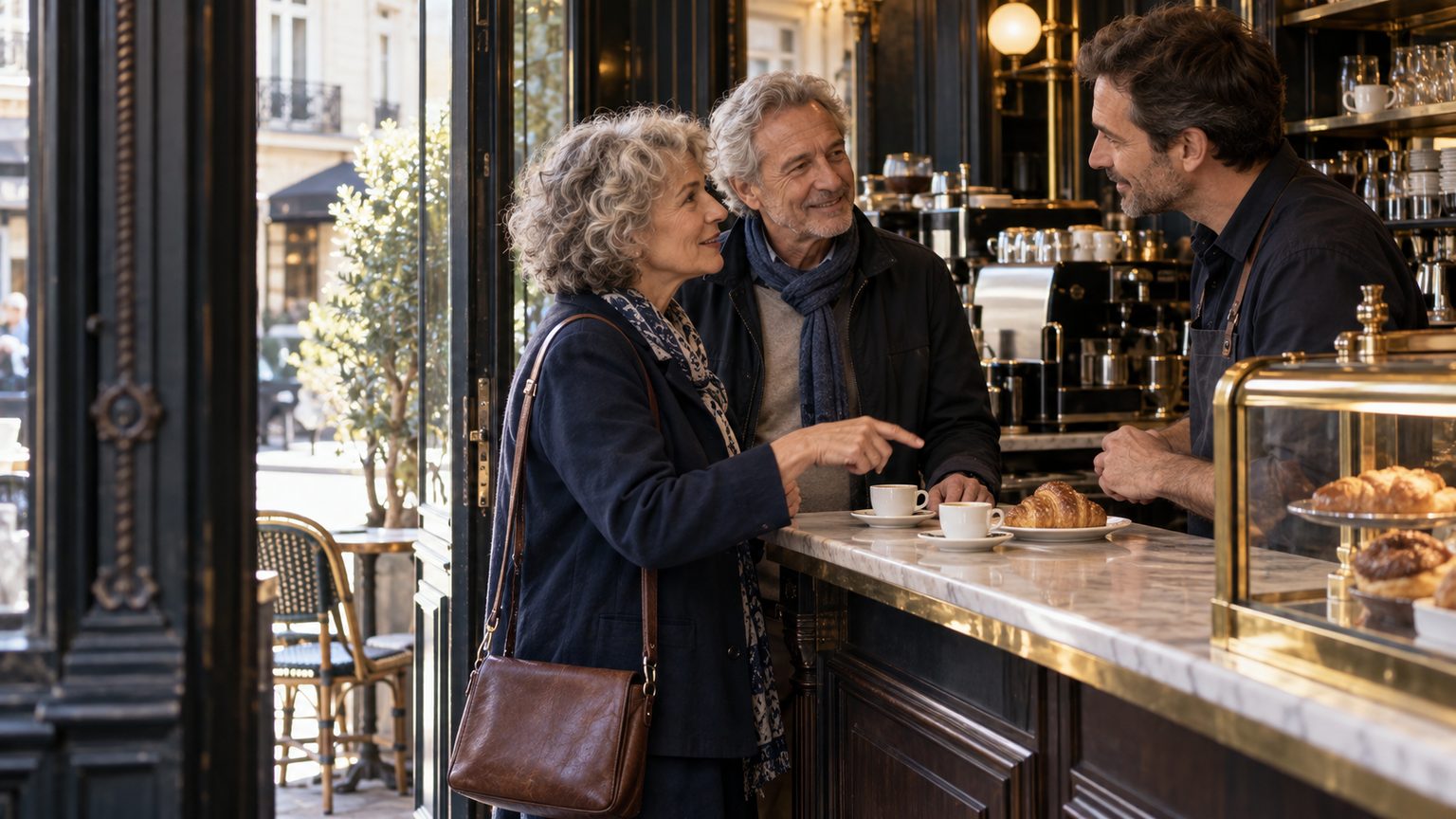
Ordering breakfast at a French café is a five-line exchange. If you learn only these, you can complete the whole thing:
It's 9am at a café near the Seine. Here's how the conversation goes — both sides of it.
This is the single most important word on this page. In France, Bonjour opens the transaction — skipping it and going straight to your order is read as genuinely rude, not merely brisk. Say it, let them answer, then order. You may also hear Je vous écoute ("I'm listening") or Vous désirez ?
Careful with "un café." On its own it means a single espresso — small, black, no mug. If you want something closer to what you drink at home, ask for un café allongé (a lengthened espresso) or un café crème (with steamed milk). Café au lait is understood everywhere, but café crème is what Parisians actually say in a café.
Pointing is a legitimate strategy. A French pastry case is full of things you have no word for. Ça, s'il vous plaît plus a finger works perfectly, and Qu'est-ce que c'est ? ("what is that?") gets you the name for next time.
This is the freeze point. You've ordered successfully, you're relaxing — and then a question arrives. In France the answer can also change the price: standing at the counter is cheaper than sitting down. Then you'll hear Voilà (vwah-LAH) as it lands in front of you.
Nobody will bring it unasked. A French server leaving you alone with an empty cup is being polite, not neglectful — presenting the bill unbidden implies you're being hurried out. Ask, and expect a warm Bonne journée ! on the way out.
Travelers rarely fail because they couldn't produce a sentence. They fail because a real person said something unscripted and fast. These four cover most of it:
25 phrases, grouped by the moment you'll need them. Prints black and white, no images. On an iPhone: Share → Print, or Share → Save to Files for a PDF.
French Café Phrases — Coffee & Breakfast
Voxolo · voxolo.app/french-cafe-phrases.html · CEFR A2 · pronunciation in italics
| Bonjour ! | Hello / Good day! | bohn-ZHOOR |
| S'il vous plaît | Please | seel voo PLEH |
| Merci beaucoup | Thank you very much | mehr-SEE boh-KOO |
| Excusez-moi | Excuse me | ex-koo-zay-MWAH |
| Parlez-vous anglais ? | Do you speak English? | par-lay-voo ahn-GLEH |
| Un café au lait, s'il vous plaît. | A coffee with milk, please. | uhn kah-FAY oh LEH |
| Un café. | An espresso. (not a mug!) | uhn kah-FAY |
| Un café crème. | Coffee with steamed milk. | uhn kah-FAY KREHM |
| Un café allongé. | A longer, weaker coffee. | uhn kah-FAY ah-lohn-ZHAY |
| Un thé, s'il vous plaît. | A tea, please. | uhn TAY, seel voo PLEH |
| Je voudrais un croissant. | I would like a croissant. | zhuh voo-DREH uhn krwah-SAHN |
| Ça, s'il vous plaît. | That one, please. (pointing) | sah, seel voo PLEH |
| Deux, s'il vous plaît. | Two, please. | duh, seel voo PLEH |
| Qu'est-ce que c'est ? | What is that? | kess-kuh SEH |
| Qu'est-ce que vous recommandez ? | What do you recommend? | kess-kuh voo ruh-koh-mahn-DAY |
| Qu'est-ce que je vous sers ? | What can I get you? | kess-kuh zhuh voo SEHR |
| Sur place ou à emporter ? | To have here or take away? | soor PLAHSS oo ah ahm-por-TAY |
| Et avec ça ? | And with that? (anything else?) | ay ah-vek SAH |
| Voilà. | There you are. | vwah-LAH |
| Bonne journée ! | Have a good day! | bun zhoor-NAY |
| Sur place. | To have here. | soor PLAHSS |
| À emporter. | To take away. | ah ahm-por-TAY |
| C'est tout, merci. | That's all, thank you. | seh TOO, mehr-SEE |
| L'addition, s'il vous plaît. | The bill, please. | lah-dee-SYOHN |
| Je peux payer par carte ? | Can I pay by card? | zhuh puh pay-YAY par KART |
Say Bonjour before you order — in France it opens the transaction and skipping it reads as rude. Un café means an espresso, not a mug. The bill never arrives until you ask for it. And the same coffee is priced differently at the counter, at a table, and on the terrace.
Want to say these out loud to someone who answers back? That's the app.
See how Voxolo worksFrench breakfast is small, sweet, and mostly viennoiserie. These are the words you'll see.
Where you sit changes the bill — legally. French cafés post separate prices for au comptoir (standing at the counter), en salle (an indoor table), and en terrasse (outside on the pavement). It is not a tourist surcharge; it's a regulated charge for the seat, and the list must be displayed. Standing at the counter can cost half what the terrace does — and the terrace is often worth every cent of the difference.
Nobody is going to rush you. A café table in France is rented by the coffee, not by the hour, and the bill will not appear until you request it. You can sit with one espresso and a book for a very long time without anyone hovering. This is the deal, and it's one of the best in Europe — just remember that leaving requires the sentence L'addition, s'il vous plaît.
The café is one of about forty situations a traveler actually walks into. Once a month we send another one — the restaurant, the pharmacy, the train ticket window — written the same way, both sides of the conversation, printable.
You're in — merci ! The next scenario guide is on its way. 🎉
Voxolo is live on the App Store, and your first lesson is free. The whole session, conversation included — no card, no account.
Get VoxoloSay Un café au lait, s'il vous plaît (uhn kah-FAY oh LEH, seel voo PLEH) for a coffee with milk. If you say only un café you'll get a single espresso. For something closer to American coffee, ask for un café allongé. Always open with Bonjour !
"To have here or to take away?" Answer Sur place if you're staying or À emporter if it's to go. In France the answer can also change what you pay, since sitting costs more than standing at the counter.
Yes — and it matters more than the rest of your French. Walking up and ordering without it is considered genuinely impolite, not just brisk. Say it, wait for the reply, then order, even if the rest of the exchange happens in English.
French cafés legally post up to three prices for the same drink: au comptoir (counter), en salle (indoor table), and en terrasse (outside). You're paying for the seat, not being overcharged, and the list must be displayed.
Because in France it only arrives when you ask. Bringing it unbidden would imply you're being hurried out. Say L'addition, s'il vous plaît when you're ready to leave.
Service is already included by law — service compris — so no tip is required. Leaving the small coins from your change is a normal gesture for good service, but nothing more is expected.
In central Paris, often yes. But the exchange above takes about twenty seconds in French, and the response you get for opening with Bonjour and trying is noticeably warmer. Start in French, switch to English if you need to.
Reading the exchange is one thing — saying it out loud, to someone who answers back differently every time, is another. Voxolo builds a speaking plan around your actual trip dates, and plays the barista, the waiter, the vendor. It's on the App Store now, and the first lesson is free.
Get Voxolo