Not a lesson about the language — a scene in it. You meet the handful of phrases the moment needs, hear the whole exchange run at full speed in native voices, and then the scene starts again with you in it and nothing written down. Here's exactly what that looks like.
Meet the five phrases this scene runs on — and say each one out loud before you go anywhere near the conversation.
Stage 2Two native voices play the scene end to end, so you hear where each phrase lands and what comes back at you.
Stage 3Same market, same vendor — except now they're talking to you, there's no script, and you answer out loud.
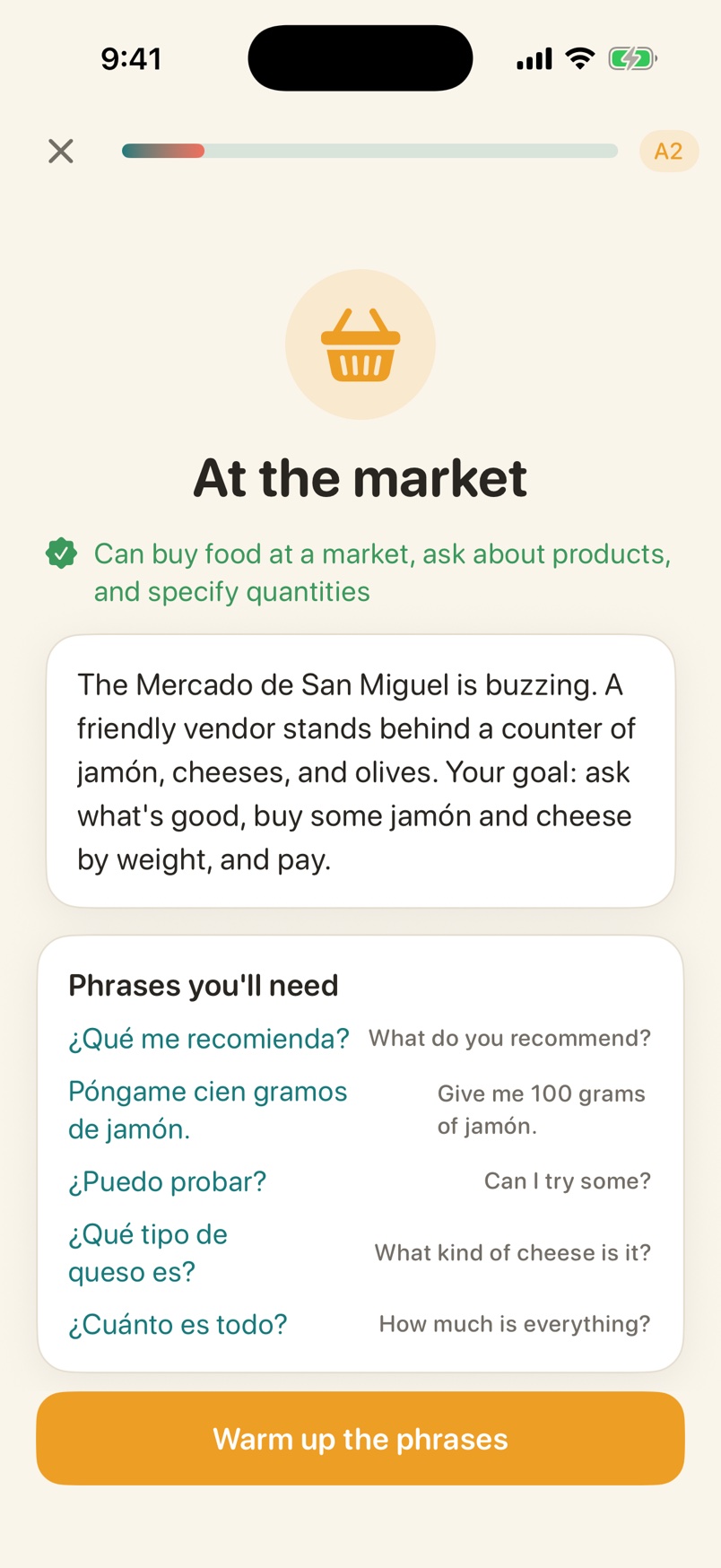
Every session opens on a scene and a goal — where you are, who's in front of you, and what you're there to walk away with. Today: a counter of jamón and cheese, a vendor waiting, and one thing to buy.
Language apps hand you a unit called Food. Voxolo hands you a stall at the Mercado de San Miguel, a vendor behind a counter of jamón and cheese, and one job: ask what's good, buy some by weight, and pay.
That difference matters more than it sounds. A topic has no end state, so you can study it forever and never know if you're ready. A scene either goes well or it doesn't — and you can tell which, immediately, in a way no progress bar can fake.
Under the goal are the phrases the scene runs on. Five of them. That's the whole vocabulary load for today.
Each phrase arrives on its own and speaks itself aloud the moment it lands — a natural, native-quality voice with real stress and rhythm, not flat robotic text-to-speech. Tap Hear it as many times as you want.
Then comes the part most apps skip. You hold the mic and say it back, and Voxolo listens — checking what it actually heard against what you were reaching for, and telling you straight away whether it landed or whether it's worth another go.
Five phrases, about ninety seconds. No conjugation tables, no matching games, no tapping the right tile out of four. The very first thing you do in a Voxolo session is speak.
Recognising a word on a screen and retrieving it in half a second at a counter are two different skills. Only the second one is any use in a market — so it's the one you start with.
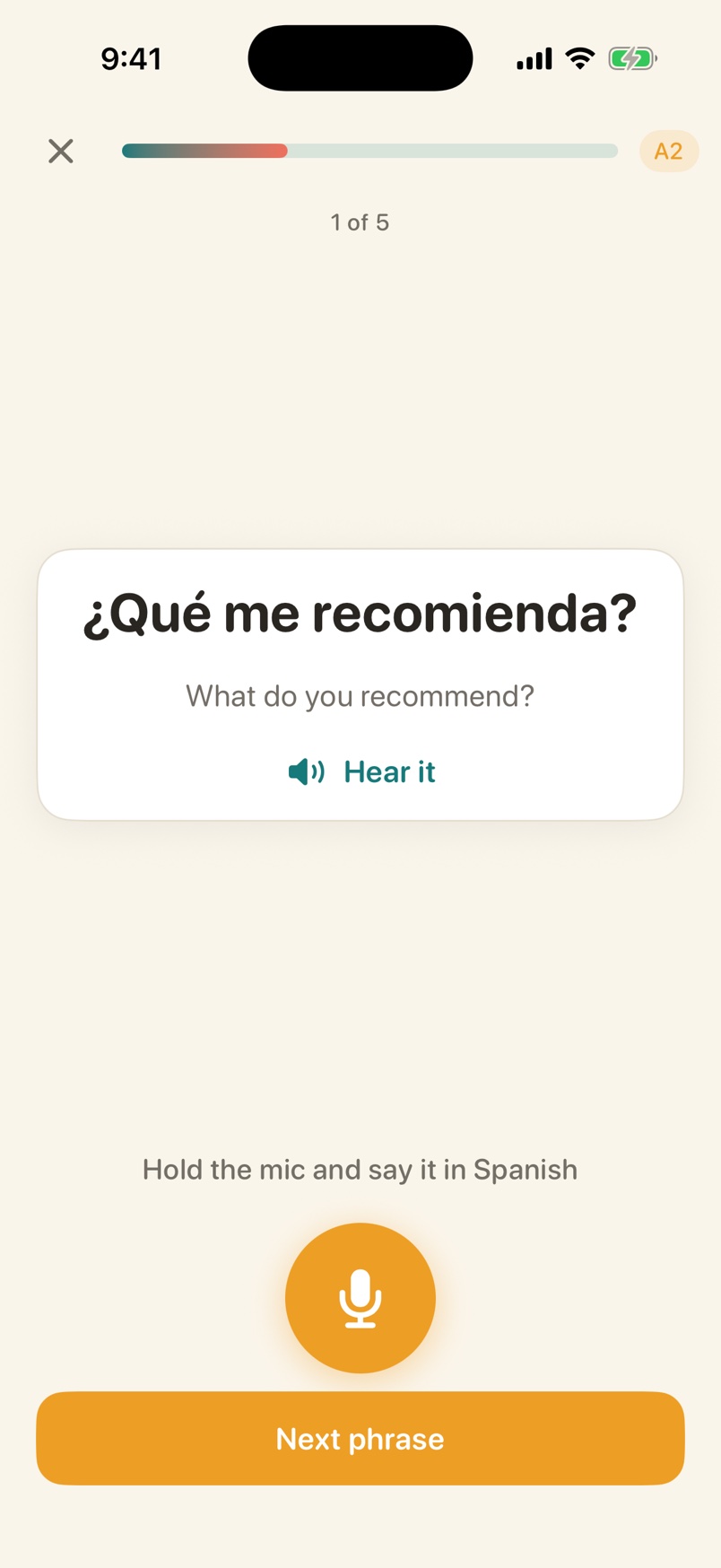
Phrase 1 of 5 — spoken aloud on arrival, then said back into the mic.
Now you watch the scene run without you. The same exchange plays out between two people in two distinct native voices, at real conversational speed — and each line lights up as it's spoken, so your eye and your ear stay together.
This is where the five phrases stop being flashcards and start being moves. You see exactly where ¿Qué me recomienda? gets you — the vendor offers the ibérico, offers a taste, and suddenly you're being asked how much you want. You watch the conversation progress: opening, question, offer, answer, close.
The English stays off behind a toggle unless you reach for it. On a street in Madrid, sound arrives well before meaning does, and this is the stage that trains for it.
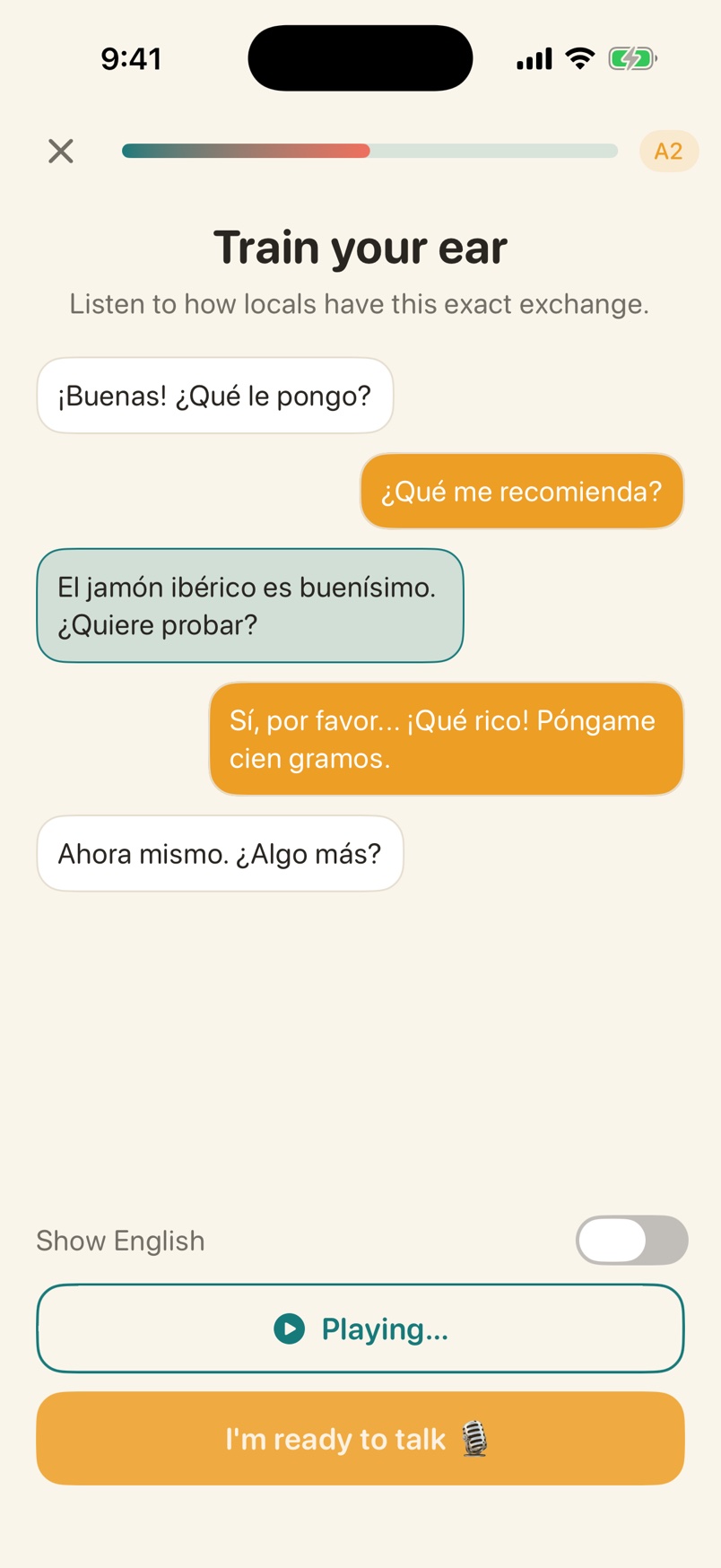
Each line highlights as it plays — vendor in one voice, traveller in another.
Same market. Same vendor. Except this time they're talking to you, nothing is written down, and the only way forward is to open your mouth.
You hold the mic and answer out loud. Voxolo replies to what you actually said — in character, as the vendor. Ask what's in the cheese, change your mind, haggle, say the wrong thing entirely: it follows you there, because there's no branching menu underneath it, just a tutor speaking Spanish back at you.
This is the stage everything else was for. It's where you find out what you can genuinely produce under time pressure — and it's a rehearsal for the one conversation that actually counts, with the enormous advantage that nobody is standing behind you in the queue.
A low-stakes place to be a beginner out loud. No class, no partner, no stranger watching you fumble the word for "cheese" — and you can run the same scene again tomorrow.
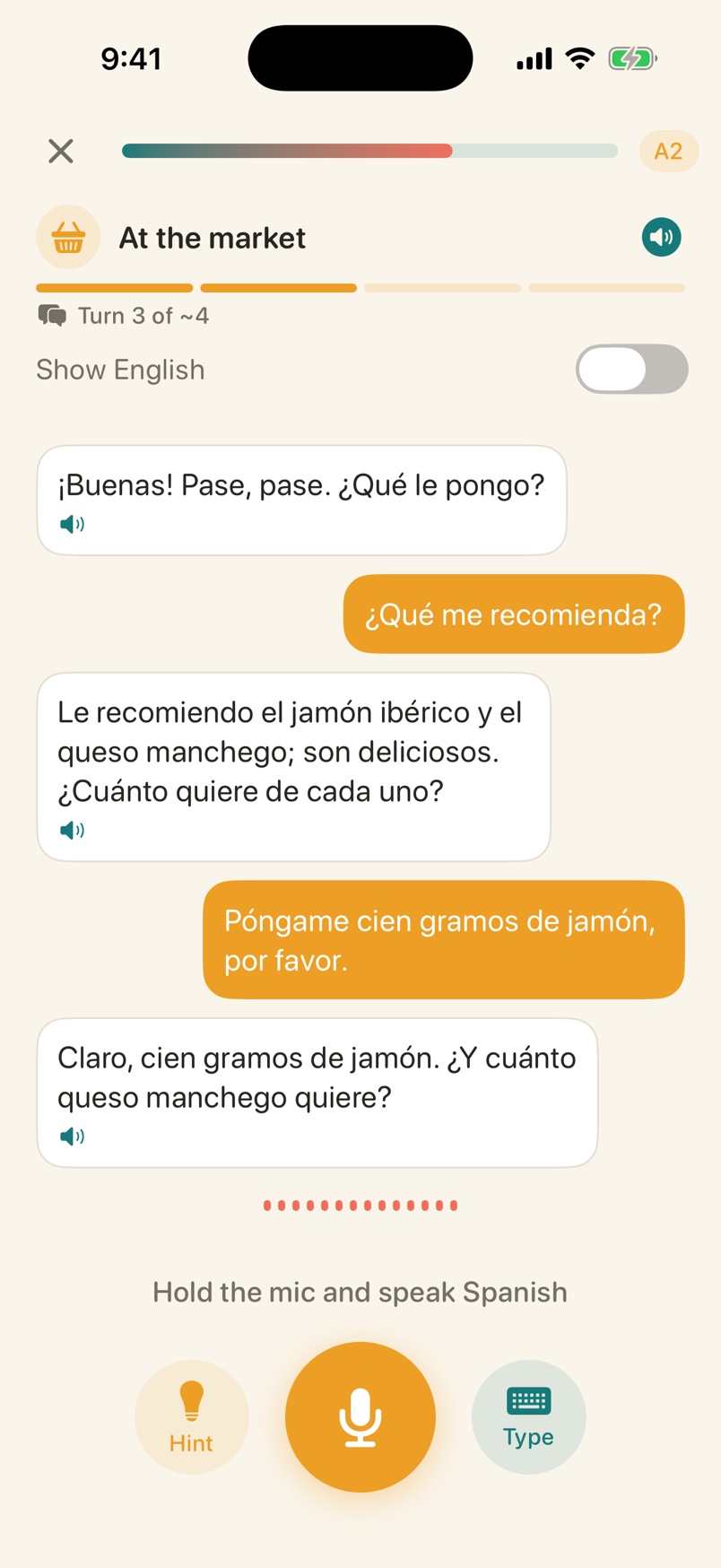
A real exchange — the vendor's replies are generated from what you said, not picked off a list.
Going in without guidance doesn't mean going in without a net. When your mind goes blank mid-scene — and it will, that's what happens in real conversations too — Hint gives you a line you could say right now.
Not a canned phrase from the list you practised. A hint written for the turn you're actually on: the vendor has just offered you a taste, so the hint is how to say yes and put in your order, in Spanish, with the English underneath and a button to hear it said properly.
Use one, use five, or use none. Voxolo counts them and tells you afterwards — because leaning on hints is fine, and knowing how much you leaned is the useful part.
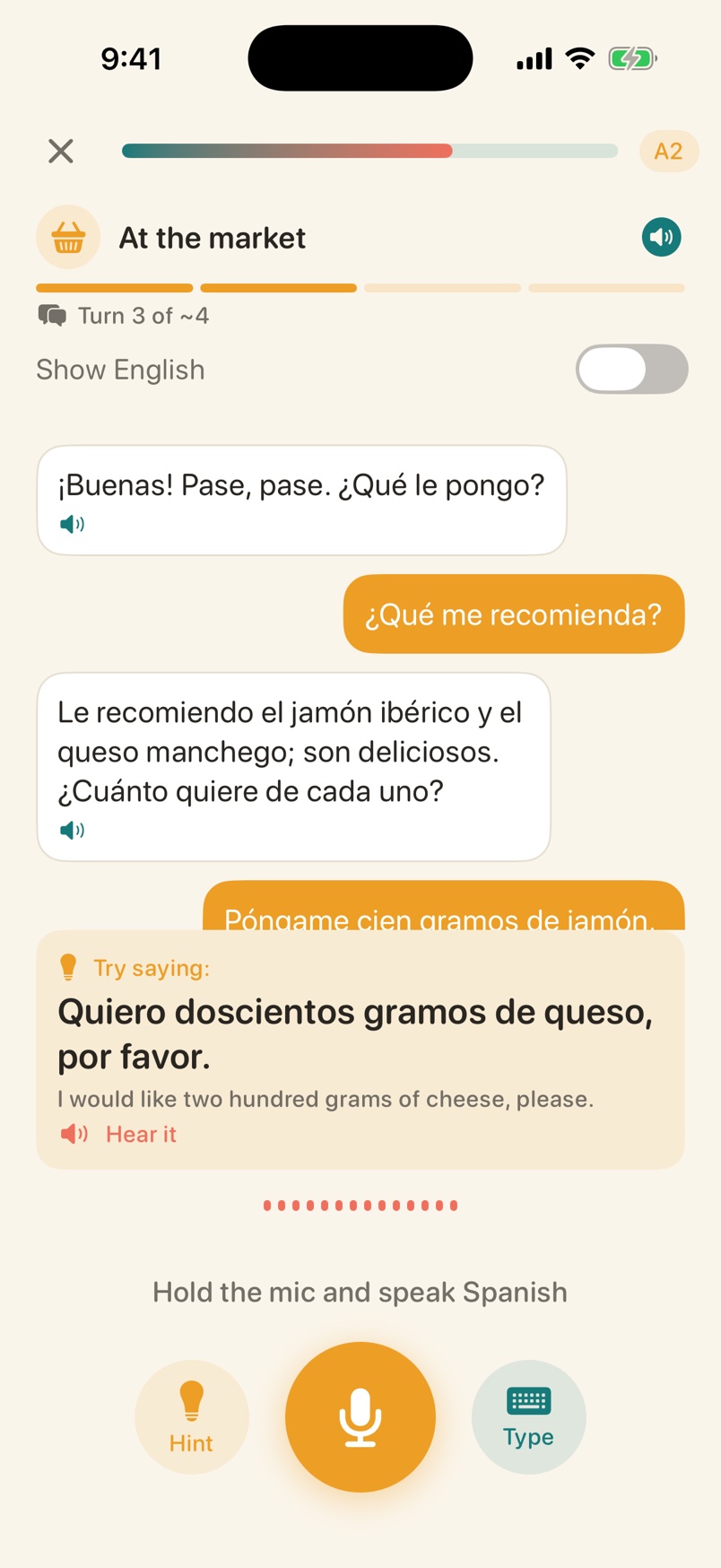
The hint is generated for the current turn — here, an answer to the question just asked.
Somewhere in that exchange the vendor will use something that was never on your list. De bellota. Al corte. Un cuarto. And you'll mostly follow it anyway — from the shape of the sentence, from what they're holding, from what they asked you ten seconds ago.
That moment is immersion doing the thing a vocabulary list structurally cannot: teaching you a word through the situation that word lives in. It's also the single most useful travel skill there is — staying in the conversation when you don't catch every word, instead of freezing and switching to English.
Every real conversation you have abroad will be full of these. Better to meet your first few at a stall that doesn't mind waiting.
Two things happen the moment you close the conversation — and neither of them is confetti for showing up.
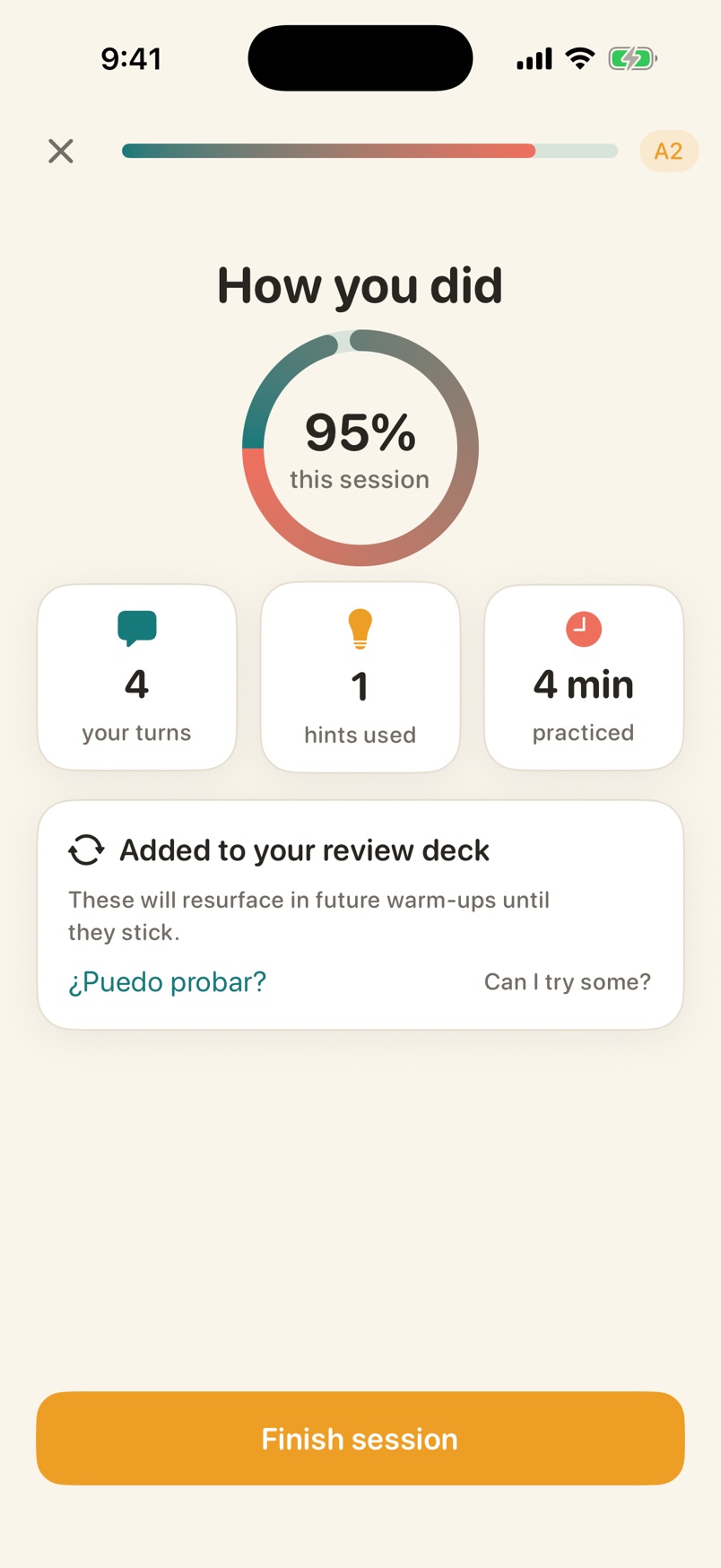
Turns you held, hints you leaned on, minutes practised, and a score for the session. Nothing is graded on participation.
Any key phrase you talked your way around lands in a review deck and resurfaces in a future warm-up until it sticks.
Then, later in your plan, the market comes back — and it's harder. The vocabulary warm-up and the listening stage fall away, so it's the conversation and nothing else. The language climbs a CEFR band. And something goes wrong: they're out of the ibérico, or the card reader won't read your card.
Which, if you've travelled at all, you'll recognise as the realistic version.
Voxolo takes your destination, your departure date and the minutes you can spare a day, and lays these sessions across your whole countdown — easing you in, climbing through the middle, and finishing with a mock-trip run where every support is gone.
The session you just read about is the free one. Every new traveler gets a complete first lesson — the phrases, the listening, and the conversation where you answer out loud. No card, no account. You'll know whether this works for you before you pay anything. Voxolo reaches the App Store shortly; leave your email and we'll tell you the day it does.